Quantum Adaptive Sensing for Accelerated MRI
My role: First author. Developed the quantum adaptive sampling method for k-space acquisition.
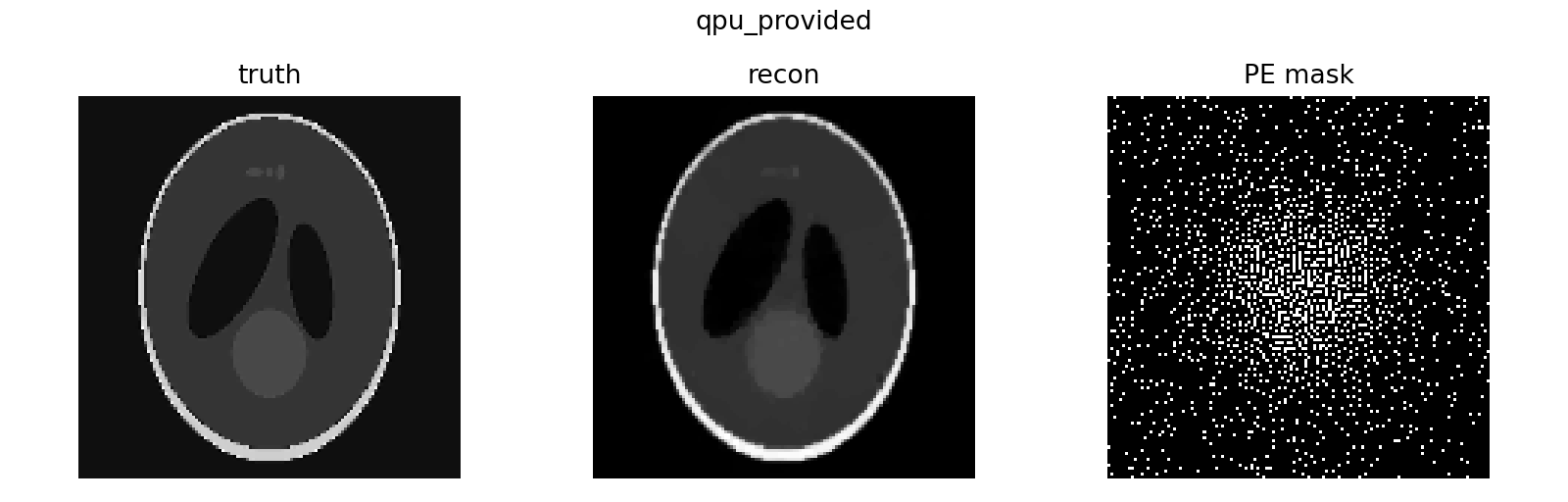
Method: Sequential phase-encode selection formulated as a fixed-cardinality QUBO, evaluated with SENSE-TV reconstruction.
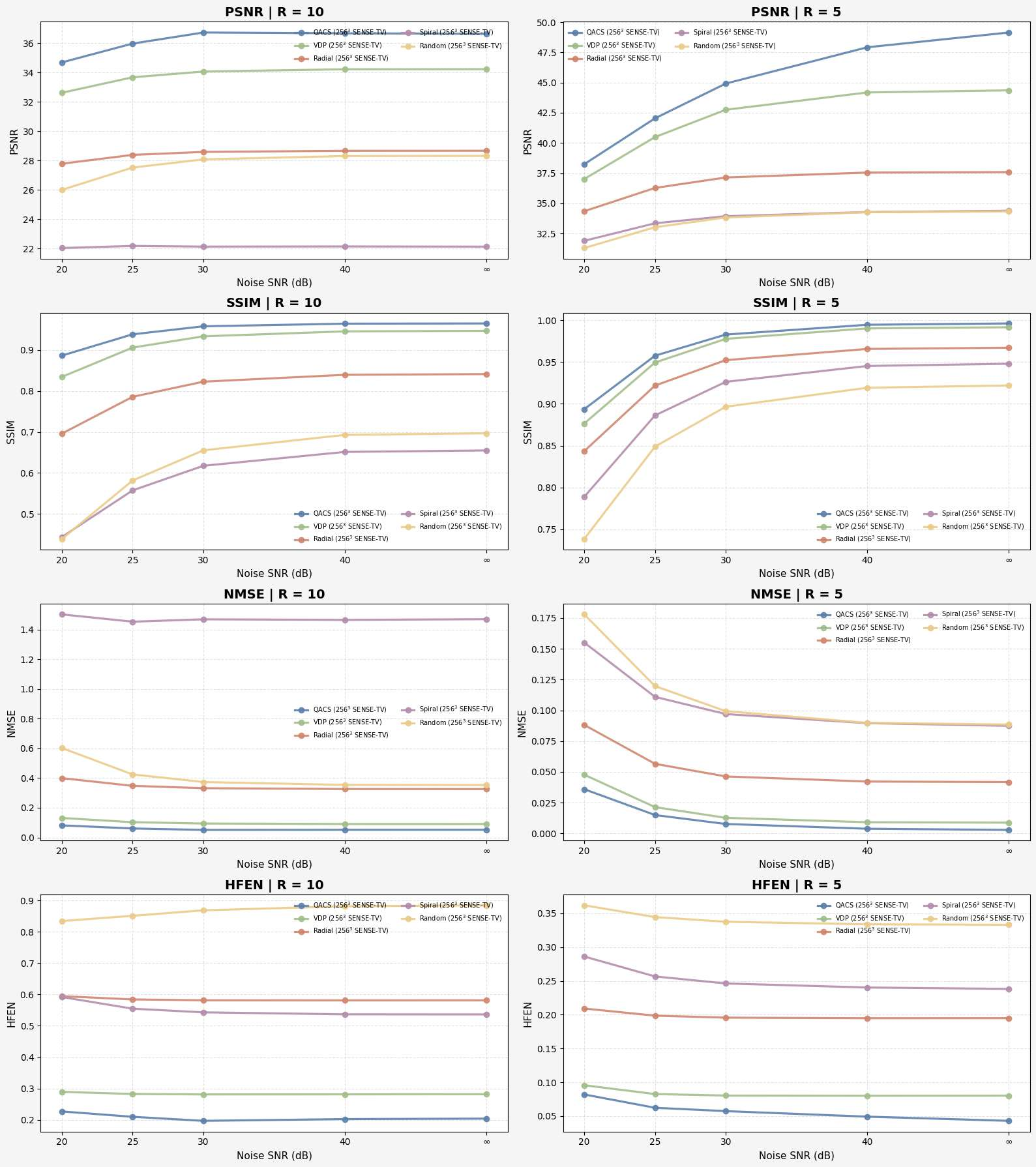
Finding: Improved reconstruction over evaluated static masks at 20% and 10% sampling in retrospective simulated eight-coil MRI.
Scope: Feasibility study; prospective scanner validation and quantum advantage remain unestablished.
Abstract
Quantum Adaptive Sensing (QACS) formulates adaptive Cartesian k-space sampling as a fixed-cardinality quadratic unconstrained binary optimization problem. Its objective balances a central k-space prior, signal energy estimated from measurements already acquired, and pairwise dispersion so that each new batch is informed by the scan itself rather than a fixed mask.
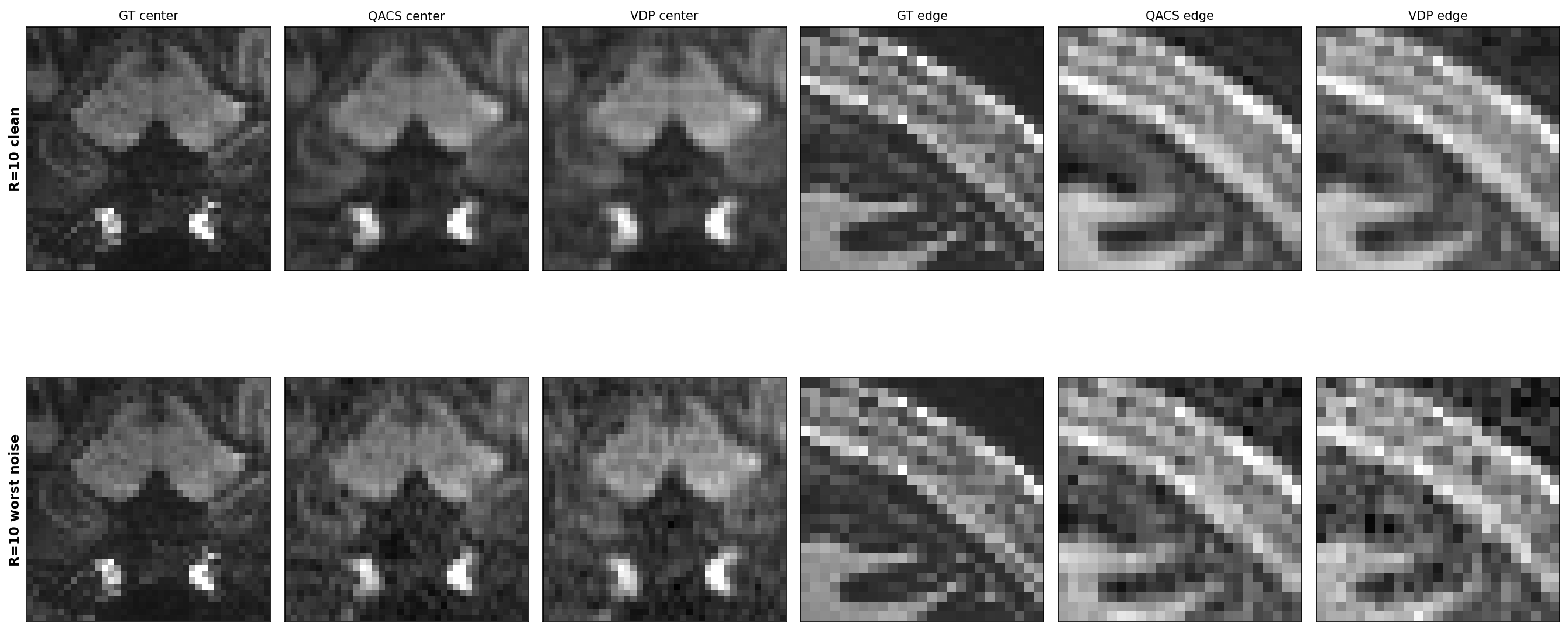
In retrospective simulated eight-coil 3D MRI, parallel-tempering optimization followed by SENSE-TV reconstruction improved PSNR, SSIM, NMSE, and HFEN over static sampling strategies including variable-density Poisson sampling. At 20% sampling on 256³ data, QACS reached 49.03 dB PSNR and 0.9962 SSIM, a 4.65 dB gain over VDP with approximately 65% lower NMSE. At 10% sampling, it retained a 2.44 dB PSNR advantage.
A reduced-pool experiment using a D-Wave hybrid solver produced reconstruction quality comparable to VDP, demonstrating compatibility with present quantum infrastructure. These results establish feasibility rather than quantum advantage; prospective scanner studies, real raw multi-coil human data, and controlled wall-clock benchmarking remain important next steps.
Keywords
Visual Overview